Septic Tank Regulations UK 2026: What Homeowners Must Know
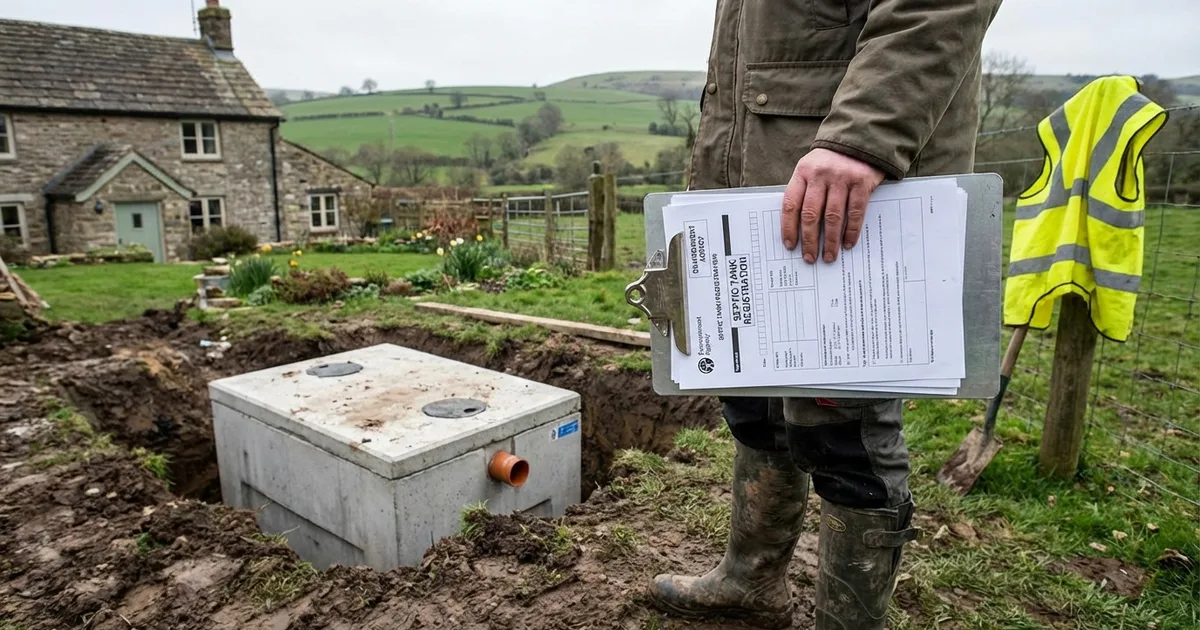
From 1 January 2020, it became illegal to discharge septic tank effluent directly into a ditch, stream, or river in England. The fine for non-compliance can reach £150,000. If you bought your home before that date and haven’t changed anything since, it is worth checking which way your system drains.
An estimated 300,000 to 500,000 homes in England and Wales rely on septic tanks. Many of those homeowners assume that because nobody has knocked on their door, everything is fine. That assumption is wrong. The septic tank regulations UK homeowners must follow changed significantly in 2020, and again in 2023. The deadline has already passed, there is no grace period, and ignorance is not a defence.
This guide focuses on England. If you are in Wales or Scotland, skip to the section on regional differences.
Below you will find the three legal scenarios your property could be in, what the rules actually require, and exactly what you need to do based on your situation. If you also have a cesspit or cesspool, the waste carrier rules at the end apply to you too.
Septic Tank Regulations UK: What the General Binding Rules Actually Are
General Binding Rules (GBR) are the legal framework governing most domestic septic tanks in England. They sit under the Environmental Permitting (England and Wales) Regulations 2016 and are enforced by the Environment Agency.
Compliance works through self-certification. If your system meets all GBR conditions, you do not need to register with anyone or apply for a permit. You simply operate and maintain it correctly. But compliance is ongoing, not a one-off. The rules apply every single day your system is running.
There are now 23 rules in total, following an update in October 2023. They cover systems discharging up to 2 cubic metres per day to ground, or up to 5 cubic metres per day to surface water. Above those volumes, you need a full Environmental Permit regardless of anything else. You can read the full rule set on the GOV.UK GBR guidance page.
Three bodies enforce these rules across the UK: the Environment Agency (EA) in England, Natural Resources Wales (NRW) in Wales, and SEPA in Scotland. Everything below focuses on England, with a separate section covering Wales and Scotland further down.
Which of These Three Scenarios Is Your System?
Whether the general binding rules for septic tanks work in your favour depends entirely on one thing: where your tank’s effluent goes. There are three scenarios.
Scenario A: Discharges to a drainage field (soakaway)
Your tank sends liquid effluent into the ground via a properly constructed drainage field meeting BS 6297:2007+A1:2008. This is the legal default. No permit needed, provided all other GBR conditions are met. Your system is emptied regularly, it does not cause pollution, and it stays within the volume thresholds. If that describes your setup, you are compliant.
Scenario B: Discharges to a ditch, stream, or river
This has been illegal since 1 January 2020. Before that date, many older tanks lawfully discharged to surface water. That is no longer the case, regardless of when the tank was installed. There is no grandfathering. You have three options:
- Install a drainage field to redirect discharge to ground.
- Replace the septic tank with a sewage treatment plant, which can legally discharge to surface water because it treats effluent to a higher standard.
- Connect to the mains sewer, if one is available nearby.
Scenario C: Cannot meet GBR for other reasons
If your system sits in a Source Protection Zone, exceeds the daily volume thresholds, or cannot satisfy all 23 GBR conditions for any reason, you must apply for an individual Environmental Permit from the EA before the system operates. Operating without one is a separate and more serious offence than simply failing a GBR condition.
If you do not know which scenario you are in, the discharge route is the single most important thing to find out. A drainage professional can confirm this in a single visit.
The 2020 Surface Water Ban: What Changed and Why It Still Catches People Out
Before 2020, many septic tanks legally discharged partially treated effluent directly to surface water. This was standard for older rural properties, and perfectly legal at the time. The septic tank regulations 2020 update changed that permanently.
From 1 January 2020, the general binding rules 2020 banned all direct discharge from septic tanks to surface water in England. The ban applies to every septic tank, no matter how old the property or when it was purchased. There is no exemption for pre-existing installations.
One distinction trips people up: the difference between a septic tank and a sewage treatment plant. A sewage treatment plant treats effluent to a much higher biological standard and can still legally discharge to surface water, provided it meets EA requirements. A septic tank cannot. If you are in Scenario B above, replacing your septic tank with a sewage treatment plant is one of the three accepted upgrade paths for exactly this reason.
Solicitors have a legal duty to disclose non-compliance at point of sale. If you purchased a property after 2020 and were not told the system discharges to surface water, your conveyancer may have failed in their obligations. That is a matter for legal advice, but it does not change your compliance position. The system still needs upgrading.
The October 2023 Update: Rules 22 and 23 (New Systems Only)
On 2 October 2023, the Environment Agency added two new rules to the GBR, bringing the total to 23. These apply to new discharges only. If your existing system is already compliant, these rules do not affect you.
Rule 22: A new discharge cannot share an outlet with another discharge if the combined daily volume would exceed the GBR thresholds (2m³/day to ground, 5m³/day to surface water). If it would, a B6.5 environmental permit is required instead.
Rule 23: A new discharge point must be at least 50 metres from any other exempt groundwater activity or water discharge activity.
If you are building a new home, adding an extension, or replacing an existing system, these rules must be factored into the design before installation. The 50-metre separation requirement in particular can affect site layout on smaller plots or in areas where neighbouring properties also have private drainage.
Septic Tank Regulations UK: GBR or Environmental Permit?
Many homeowners are unsure whether they need to apply for a formal permit from the Environment Agency. The answer is simpler than most people expect.
GBR means self-certification. If all 23 conditions are met, you operate legally by complying. You do not inform the EA, you do not fill in a form, and you do not pay a fee. You just maintain your system correctly.
An Environmental Permit is a formal application you must submit and receive before the system operates. You need one if:
- Your system cannot meet all GBR conditions
- You are in or near a sensitive area (Source Protection Zone, SSSI)
- Your discharge volume exceeds 2m³/day to ground or 5m³/day to surface water
- Your new system triggers Rule 22 or Rule 23
Operating without a required permit is an offence in its own right. The permit type for small sewage discharges is B6.5, and applications are made through the EA’s environmental permitting regime on GOV.UK.
Penalties for Non-Compliance
The EA does not treat these rules as guidelines. It investigates complaints, follows up on reports from water companies, and prosecutes. Here is what non-compliance can cost you:
| Offence | Maximum Penalty |
|---|---|
| Breach of EA enforcement notice | Up to £150,000 |
| General environmental offence | Up to £50,000 and/or 12 months imprisonment |
| Pollution incident (visible harm to watercourse) | Fines exceeding £100,000 |
Beyond fines, the EA can require immediate remedial action and prosecute separately for failure to comply with that requirement. These are not dusty maximum figures that never get applied. Enforcement notices are issued, and cases do reach court.
What You Need to Do, by Situation
If you are an existing homeowner
- Identify your discharge route. Drainage field means you are likely compliant. Surface water means you are not, and action is required immediately.
- Check your tank is emptied at least once per year by an EA-registered Upper Tier waste carrier.
- Keep records of every emptying: date, contractor name, registration number, volume removed.
- If you are unsure about your discharge route, have the system inspected by a drainage professional. A standard drainage survey typically takes a single visit. You can check typical costs in your area or search for a registered company on our homepage.
If you are selling a property
The septic tank regulations when selling a house are clear. Your solicitor must confirm in writing whether the system is GBR-compliant. Gather your evidence before it is requested: emptying records, drainage field inspection results, and confirmation of the discharge route.
A non-compliant system typically needs remediation before exchange, or the purchase price will be adjusted to reflect the cost of upgrading. Environmental searches (CON29DW) will flag any property not on mains sewer, and the buyer’s solicitor will ask detailed questions about compliance.
If you are buying a property
- Request a drainage survey as part of your due diligence. Ask specifically about the discharge route.
- Confirm the last emptying date and who carried it out. It should be a registered waste carrier.
- If the system is non-compliant, negotiate: either a price reduction that covers the upgrade cost, or require the seller to remediate before exchange.
If you are installing a new system
- Rules 22 and 23 apply. Factor in the 50-metre separation requirement from the design stage.
- Check whether your location is in a Source Protection Zone using the EA’s interactive map.
- Confirm whether you need an Environmental Permit rather than relying on the GBR before any installation work begins.
England, Wales, and Scotland: What’s Different
England: The full GBR regime as described throughout this guide. All 23 rules apply, including Rules 22 and 23 from October 2023. Enforced by the Environment Agency.
Wales: Broadly similar GBR to England, administered by Natural Resources Wales (NRW). The 2020 surface water discharge ban also applies in Wales. However, Rules 22 and 23 are England-only. Wales has separate arrangements for new system installations.
Scotland: A different regime entirely. Private drainage is regulated by SEPA under the Water Environment (Controlled Activities) (Scotland) Regulations 2011. Septic tanks are not banned from discharging to surface water in the same blanket way as England. Instead, systems must be registered with SEPA and meet individual licence conditions.
If you are in Scotland, ignore advice aimed at England. SEPA registration and your licence conditions are what govern your system, not the GBR.
Why Your Waste Carrier Must Be EA-Registered
GBR require that a septic tank be emptied and maintained so that it does not cause pollution. The widely cited guidance is at least once per year, though exact frequency depends on household size and tank capacity. You can read more in our guide on how often to empty your septic tank.
What many homeowners overlook is this: septic tank waste is classified as controlled waste under the Environmental Protection Act 1990. Controlled waste must be removed by a registered Upper Tier waste carrier licensed by the Environment Agency. Using an unlicensed contractor is illegal, and the homeowner can be held liable, not just the contractor.
This is not a technicality. If the EA investigates a pollution incident at your property, they will ask for your emptying records. If those records show an unlicensed contractor, or if you have no records at all, you have no defensible compliance position. The burden falls on you as the property owner.
Septic Tank Register UK lists only EA-registered Upper Tier waste carriers. You can check a company’s registration status before booking, which gives you a defensible record if the EA ever asks for your emptying history.
Now you know the rules, and you know what your system needs. If your next step is finding a registered emptying company, you can check what septic tank emptying costs in your area or search by county below.
Find an EA-Registered Emptying Company Near You
Every company in our directory is verified against the official EA waste carrier register. Search by region, county, or city.
Search Verified Companies →