Off-Mains Drainage Explained: Your Options in 2026
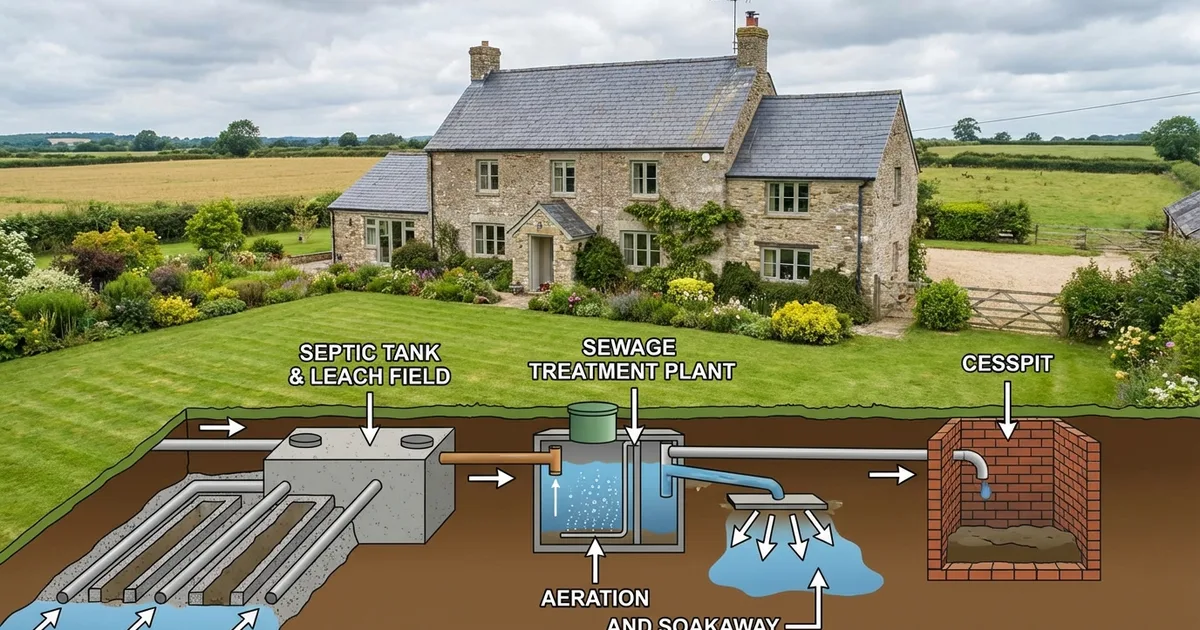
Roughly one in every twenty UK properties is not connected to the public sewer. If you are buying a rural property, planning a self-build, or already living off the mains network, the drainage system under your garden is one of the most important things you need to understand. It affects your running costs, your legal obligations, and what you can and cannot do with wastewater from your home.
This guide covers every off-mains drainage option available in the UK in 2026, the regulations you must follow, and a practical framework for choosing the right system for your property.
What Is Off-Mains Drainage?
Off-mains drainage is any private system that handles household wastewater on properties not connected to the public sewer network. Instead of your waste flowing into a local authority sewer, it is treated or stored on your own land.
Around 5% of UK properties use off-mains drainage. The vast majority are in rural areas where laying a sewer connection would be impractical or prohibitively expensive. If your property is more than 30 metres from a public sewer, the Environment Agency generally accepts that off-mains drainage is a reasonable solution.
There are three main types of off-mains drainage system: septic tanks, sewage treatment plants, and cesspits. Each handles waste differently, costs different amounts to install and run, and carries different regulatory requirements. Understanding the differences is essential before you commit to a system.
The Three Main Off-Mains Drainage Systems
Septic Tanks
A septic tank is the most common type of off-mains drainage in the UK. It is an underground tank, usually with two chambers, that separates solid waste from liquid waste using gravity.
Wastewater flows into the first chamber, where heavy solids sink to the bottom as sludge and lighter materials (fats and grease) float to the top as scum. The liquid in the middle, known as effluent, flows through a dividing wall or pipe into a second chamber for further settling. The partially treated effluent then drains out of the tank into a drainage field (also called a soakaway), where it percolates through the soil for final natural treatment.
Septic tanks do not treat wastewater to a high standard. The effluent leaving the tank still contains bacteria and nutrients, which is why it must pass through a drainage field rather than being discharged directly into a ditch or stream. Under the General Binding Rules, septic tanks in England can no longer discharge to watercourses.
- Installation cost: £2,000–£5,000 for the tank, plus £1,500–£3,000 for the drainage field
- Emptying frequency: Every 1–3 years depending on household size
- Emptying cost: £150–£300 per visit
- Annual running cost: £150–£400
- Electricity required: No
- Best for: Properties with suitable soil and enough land for a drainage field
Sewage Treatment Plants (Domestic STPs)
A domestic sewage treatment plant does everything a septic tank does, then goes further. After the initial settlement stage, the system introduces air into the wastewater using a pump or compressor. This oxygen-rich environment encourages aerobic bacteria to break down organic matter far more effectively than the passive anaerobic process in a septic tank.
The result is significantly cleaner effluent. While a septic tank removes around 30–40% of pollutants, a well-maintained sewage treatment plant removes 90–95%. This higher treatment standard means the effluent is clean enough to be discharged directly into a watercourse (a ditch, stream, or river), provided you hold an Environment Agency permit.
Sewage treatment plants are more complex than septic tanks. They have mechanical and electrical components that require a permanent power supply and annual servicing. However, they need emptying less frequently and offer greater flexibility in where you can discharge the treated water.
- Installation cost: £3,000–£8,000 (unit, groundwork, and connection)
- Emptying frequency: Every 12–24 months (sludge removal)
- Emptying cost: £150–£300 per visit
- Annual running cost: £200–£500 (electricity + servicing)
- Electricity required: Yes
- Best for: Properties near watercourses, sites with poor soil drainage, or new-build projects
Cesspits (Cesspools)
A cesspit is the simplest and most expensive-to-run off-mains drainage option. It is a sealed underground tank that stores all wastewater from the property. There is no treatment, no separation, and no discharge. Everything goes in, and nothing comes out until a tanker arrives to empty it.
Because cesspits store 100% of a household's wastewater with no treatment or discharge, they fill up fast. A family of four can fill a large cesspit in 4–8 weeks. Each emptying costs £200–£500 depending on tank size, and you might need 6–12 emptyings per year. Annual running costs of £2,000–£4,000 are common, and larger households can spend even more.
Cesspits are generally only used where no other option is viable. If the soil on your property cannot support a drainage field and there is no watercourse nearby for a treatment plant discharge, a cesspit may be your only legal option. They are banned for new installations in Scotland and heavily restricted elsewhere.
- Installation cost: £2,000–£4,000
- Emptying frequency: Every 4–8 weeks
- Emptying cost: £200–£500 per visit
- Annual running cost: £2,000–£4,000+
- Electricity required: No
- Best for: Sites where no drainage field or watercourse discharge is possible (last resort)
Off-Mains Drainage Comparison Table
Here is a side-by-side comparison of the three main off-mains drainage systems to help you evaluate your options:
| Feature | Septic Tank | Sewage Treatment Plant | Cesspit |
|---|---|---|---|
| How it works | Settles solids, effluent to drainage field | Settles + aerobic treatment, clean discharge | Sealed storage only, no treatment |
| Emptying frequency | Every 1–3 years | Every 1–2 years | Every 4–8 weeks |
| Annual running cost | £150–£400 | £200–£500 | £2,000–£4,000+ |
| Installation cost | £3,500–£8,000 (inc. drainage field) | £3,000–£8,000 | £2,000–£4,000 |
| Discharge to watercourse? | No (banned since 2020) | Yes (with EA permit) | No (sealed tank) |
| Needs electricity? | No | Yes | No |
| Drainage field required? | Yes | No (can use one, but not required) | No |
| Best for | Rural properties with suitable soil | New builds, sites near water, poor soil | Last resort where no other option works |
The comparison is clear: cesspits are the most expensive to run by a wide margin. If you are currently using a cesspit, upgrading to a septic tank or sewage treatment plant will almost always save you money within one to three years.
Off-Mains Drainage Regulations in 2026
Off-mains drainage in England is governed by the General Binding Rules (GBRs), introduced by the Environment Agency in 2015 and updated in January 2020. These rules replaced the old system of individual permits for most domestic properties and set clear standards for how private drainage systems must operate.
The General Binding Rules (England)
The key requirements under the General Binding Rules are:
- No discharge to watercourses from septic tanks. Since 1 January 2020, septic tanks in England can no longer discharge effluent directly into a ditch, stream, river, or any other watercourse. Effluent must go to a drainage field that meets British Standard BS 6297.
- Sewage treatment plants can discharge to watercourses, but only if the system produces effluent that meets the required standard (typically 20mg/l BOD, 30mg/l suspended solids) and you hold an Environment Agency permit.
- Maximum daily discharge of 2 cubic metres per day to the ground, or 5 cubic metres per day to surface water.
- No discharge within 50 metres of a drinking water supply, borehole, or well.
- Systems must be maintained in good working order and must not cause pollution, a health hazard, or a nuisance.
- Annual inspection is recommended, and records of maintenance and emptying should be kept.
If your system meets all the General Binding Rules, you do not need a separate environmental permit. If it does not meet them (for example, your daily discharge exceeds 2 cubic metres), you must apply for an environmental permit from the EA.
Scotland and Wales
Scotland and Wales have their own regulations. In Scotland, private drainage is regulated by SEPA (Scottish Environment Protection Agency), and cesspits are banned for new installations. In Wales, Natural Resources Wales (NRW) oversees private drainage. The principles are similar to England, but the specific rules and permit requirements differ. If you are in Scotland or Wales, check with your local environmental regulator before installing or modifying a system.
Building Regulations
Any new off-mains drainage installation requires Building Regulations approval under Approved Document H (drainage and waste disposal). This applies to new-build properties and to replacements or upgrades of existing systems. Your local authority building control team will need to approve the design and inspect the installation. A percolation test (to assess soil drainage) is normally required before a drainage field can be approved.
How to Choose the Right System
Choosing the right off-mains drainage system depends on your site conditions, budget, and household size. Here is a practical decision framework:
1. Check Your Soil
A percolation test determines whether your soil can absorb effluent effectively. If the soil drains well (sandy, loamy, or chalk soils), a septic tank with a drainage field is usually the simplest and cheapest option. If the soil drains poorly (heavy clay, waterlogged ground), a drainage field will not work, and you will need a sewage treatment plant that discharges to a watercourse, or a cesspit as a last resort.
2. Check for Watercourses
If there is a ditch, stream, or river on or near your property, a sewage treatment plant with a watercourse discharge may be the best option. You will need an Environment Agency permit, but the ongoing costs are lower than a cesspit, and you avoid the need for a drainage field altogether.
3. Assess Your Plot Size
A drainage field needs space. The exact size depends on soil type and household size, but a typical domestic drainage field is 30–80 square metres. If your plot is too small for a drainage field, a sewage treatment plant with watercourse discharge or a cesspit is the fallback.
4. Consider Your Budget
Upfront costs matter, but running costs matter more over the life of the system. A cesspit is cheap to install but cripplingly expensive to run. A sewage treatment plant costs more upfront but has moderate running costs. A septic tank sits in the middle on both counts.
5. Factor in Household Size
Larger households generate more wastewater, which affects tank sizing and emptying frequency. A family of five will fill a cesspit in four weeks and need a larger septic tank or treatment plant than a couple. Make sure the system you choose is rated for your household's daily water usage.
Decision Summary
- Good soil + space for drainage field → Septic tank (cheapest overall)
- Poor soil + nearby watercourse → Sewage treatment plant (clean discharge, moderate cost)
- Good soil + want cleaner discharge → Sewage treatment plant with drainage field (best environmental outcome)
- Poor soil + no watercourse + no space → Cesspit (expensive, but may be your only legal option)
Installation Costs for Off-Mains Drainage Systems
Here is a full breakdown of installation costs for each system type, including groundwork, the unit itself, drainage field (where applicable), and connection to the property:
| Cost Element | Septic Tank | Sewage Treatment Plant | Cesspit |
|---|---|---|---|
| Unit (tank/plant) | £800–£2,500 | £2,000–£5,000 | £1,000–£2,500 |
| Excavation & groundwork | £1,000–£2,500 | £1,000–£3,000 | £800–£1,500 |
| Drainage field | £1,500–£3,000 | £0–£3,000 (optional) | N/A |
| Pipework & connection | £500–£1,000 | £500–£1,000 | £300–£700 |
| Electrical supply | N/A | £200–£500 | N/A |
| Building regs & percolation test | £300–£500 | £300–£500 | £200–£400 |
| Total installed | £4,000–£9,500 | £4,000–£13,000 | £2,300–£5,100 |
These figures include VAT and are based on typical domestic installations in 2026. Costs can be higher for difficult access, rocky ground, or properties in remote locations where contractors charge travel premiums. Always get at least three quotes from specialists and confirm that they are experienced with your chosen system type.
What About Existing Systems?
If you already have an off-mains drainage system, you may need to upgrade it. There are several situations where this becomes necessary.
Upgrading from a Cesspit
If you are spending £2,000–£4,000 a year on cesspit emptying, switching to a septic tank or sewage treatment plant makes strong financial sense. A sewage treatment plant costing £6,000–£10,000 to install will pay for itself within two to four years through dramatically lower running costs. Many homeowners report saving over £2,000 per year after the switch.
Upgrading a Septic Tank for GBR Compliance
If your septic tank currently discharges to a watercourse (a ditch or stream), it has been non-compliant since January 2020. You have three options:
- Install a drainage field so the septic tank discharges to the ground instead (£1,500–£3,000, subject to a passing percolation test).
- Replace the septic tank with a sewage treatment plant that is permitted to discharge to the watercourse (£4,000–£10,000 including removal of the old tank).
- Connect to the mains sewer if one is within 30 metres of your property (costs vary widely).
When You Must Upgrade
The Environment Agency can require you to upgrade at any time if your system is causing pollution. In practice, the most common trigger points are:
- Selling the property. Conveyancing solicitors now routinely check drainage compliance. A non-compliant system can delay or prevent a sale.
- Evidence of pollution. If effluent is reaching a watercourse from a septic tank, you are in breach of the General Binding Rules and may face enforcement action.
- Building work. Extensions or renovations that increase the number of bedrooms may require an upgrade to handle the additional wastewater.
If you are unsure whether your current system is compliant, ask a drainage specialist to inspect it. An inspection typically costs £100–£250 and will tell you exactly where you stand.
Find a Registered Drainage Company Near You
Whether you need a new off-mains drainage installation, an upgrade to meet current regulations, or routine emptying and maintenance, find an EA-registered company in our directory.
Search the DirectoryFrequently Asked Questions
What is off-mains drainage?
Off-mains drainage is any private system used to treat or store household wastewater on properties not connected to the public sewer network. Around 5% of UK properties use off-mains drainage. The three main types are septic tanks, sewage treatment plants, and cesspits (cesspools).
How much does off-mains drainage cost to install?
Installation costs vary by system type. A septic tank costs £4,000–£9,500 fully installed (including drainage field). A sewage treatment plant costs £4,000–£13,000 installed. A cesspit costs £2,300–£5,100 installed but has much higher running costs of £2,000–£4,000 per year for frequent emptying.
Do I need planning permission for off-mains drainage?
You do not normally need planning permission for a like-for-like replacement of an existing system. New installations on new-build properties require Building Regulations approval under Approved Document H. If your system will discharge treated effluent to a watercourse, you need an environmental permit from the Environment Agency. All systems must comply with the General Binding Rules.
What are the regulations for off-mains drainage in 2026?
In England, off-mains drainage is governed by the General Binding Rules. Since January 2020, septic tanks can no longer discharge to watercourses and must use a drainage field. Sewage treatment plants can discharge to a watercourse with an EA permit. Systems must be maintained in good working order, should be inspected annually, and must not cause pollution. Scotland and Wales have separate but similar regulations under SEPA and NRW respectively.
Which is better: a septic tank or a sewage treatment plant?
It depends on your site. A sewage treatment plant produces cleaner effluent and can discharge to a watercourse (with a permit), making it the better choice for properties near water or with poor soil drainage. A septic tank costs less upfront, has no moving parts, and needs no electricity, making it simpler if your site has suitable soil for a drainage field. For new installations, sewage treatment plants are increasingly preferred because they offer more flexibility and meet stricter environmental standards.