How to Find Your Septic Tank (and Check if It Needs Emptying)
Your water bill only shows a “water supply” charge, with no sewerage line. Or your solicitor mentioned “off-mains drainage” in the conveyancing pack and moved on quickly. Either way, you now need to find your septic tank, something buried in the garden that previous owners never told you about.
Around 960,000 UK homes sit on off-mains drainage, roughly 4 to 5% of all properties. The proportion is higher in rural England, Wales, and Scotland. If you have just moved from a town to the countryside, you have probably never had to think about where your sewage goes. That changes today.
Do You Actually Have a Septic Tank?
Before you start probing the lawn, confirm that you are actually on off-mains drainage. The quickest check is your water bill. If there is a “sewerage” charge, you are connected to the public sewer and can stop reading here. If the bill only shows a water supply charge, or you have a private borehole, you almost certainly have a private drainage system.
Property type gives you a strong clue. Rural homes, farmhouses, and anything built before the 1970s are far more likely to have private drainage. Properties from that era were often built before mains sewerage reached their area, and many were never connected even when it did. A terraced house in a town centre is almost certainly on mains.
Your most reliable written confirmation is the TA6 Property Information Form in the conveyancing pack. The seller is legally required to declare the drainage type on this document. If you have already completed, your solicitor should still have a copy on file.
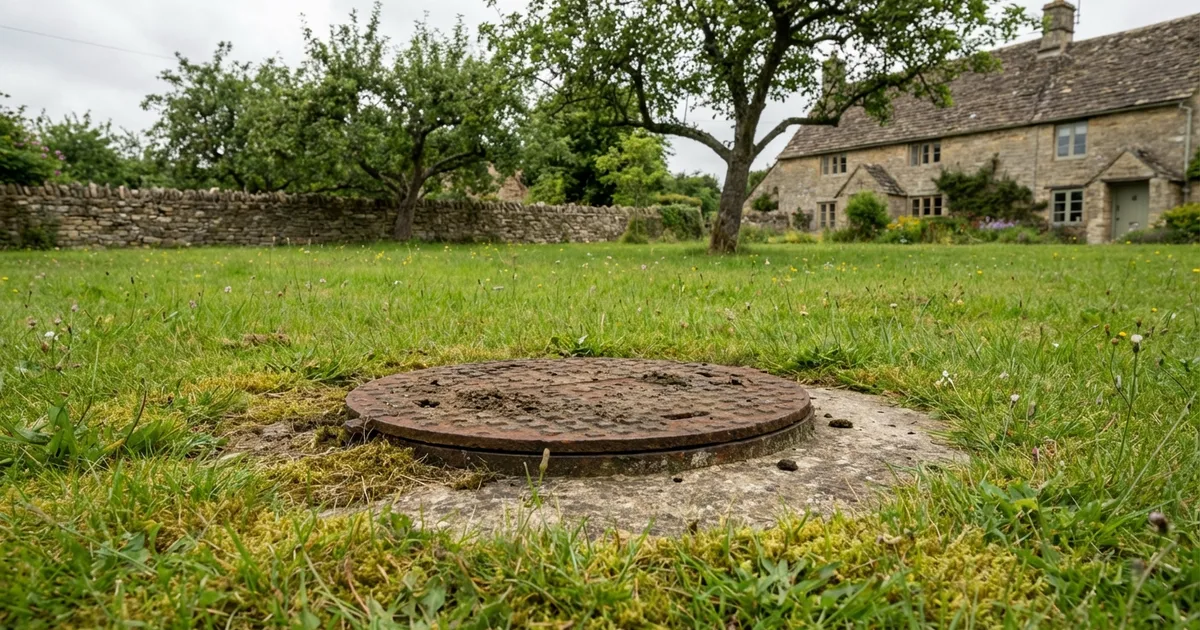
Walk the garden and look for physical signs: a concrete or plastic lid (typically 450 to 600mm in diameter, often green or grey), an inspection chamber cover, or a manhole cover that does not connect to the street sewer. In rural communities, ask your neighbours too. Adjacent properties often share the same drainage setup, and a five-minute conversation can save you an hour of searching.
How to Find Your Septic Tank: 5 Methods in Order
Work through these methods in order. Most people find their septic tank location using the first or second method. If you need to reach method five, you are dealing with an unusual site.
Method 1: Follow the outflow pipe
This is the fastest approach. Inside the house, find the main soil pipe. It is typically 100 to 110mm in diameter, white or grey PVC, and exits through the ground floor or below floor level. Go outside and identify where the pipe leaves the building.
The tank almost always sits directly in line with this exit point, typically 1.5 to 8 metres from the house wall. Walk the straight-line path from the exit and look for a lid, an inspection cover, or a slight change in ground level. In most domestic installations, the tank sits within about 5 metres of the house.
Method 2: Check property documents
Building regulations approval from when the tank was installed should include a site plan showing the exact position. If the property was extended or modified with planning permission, the application drawings (searchable on your local council’s online planning portal) sometimes show the tank location too.
The Land Registry title register may reference drainage documents. You can download yours for £3 from gov.uk/get-information-about-property. If none of these produce results, contact the previous owners directly. Most sellers are willing to answer a quick question about something they dealt with for years.
Method 3: Read the garden
Your garden gives you several visual clues if you know what to look for.
| Visual Clue | What It Means |
|---|---|
| Circular concrete or plastic lid, vent pipe, or inspection chamber cover | Direct marker of the tank or its access point |
| Slightly raised or sunken patch of ground | Tanks settle over time, creating subtle ground-level changes |
| Unnaturally lush, dark green grass in an oval or circular patch | Nutrient-rich effluent feeding roots from below |
| Snow melting faster in one area than the rest of the garden | Bacterial activity inside the tank generates heat |
The lush grass clue is the one most people notice first, especially in late spring when the contrast against the surrounding lawn is strongest.
Method 4: Probe the ground
If the visual clues have narrowed the search area but you cannot see a lid, use a long metal rod such as an electric fence stake or steel bar. Insert it vertically into the ground along the suspected path, probing every 0.5 to 1 metre. When you hit the tank lid or concrete surround, you will feel a distinct hollow thud rather than the steady resistance of soil.
Method 5: Professional location
If you cannot find the tank within an hour using the methods above, call a drainage specialist. They use CCTV drain tracing, sonde equipment (a radio transmitter pushed through the drain), or acoustic equipment to pinpoint the tank precisely. This typically costs £100 to £300.
Most domestic tanks sit between 0.5 and 1 metre below ground level. If yours is deeper, or if the garden has been heavily landscaped, paved over, or the property is a converted barn with no original documentation, professional location is the sensible route.
Septic Tank, Cesspit, or Sewage Treatment Plant: Which Do You Have?
The type of system you have determines your legal obligations and how often you need it emptied. There are three possibilities.
| Indicator | Septic Tank | Sewage Treatment Plant | Cesspit |
|---|---|---|---|
| Has an outlet pipe | Yes (to soakaway) | Yes (treated effluent) | No, sealed |
| Has electrical components | No | Yes (pump, blower) | No |
| Typical emptying frequency | Once per year | 1 to 2 times per year | Every 6 to 8 weeks |
| Typical shape | Rectangular concrete or oval plastic | Cylindrical | Rectangular concrete |
The quickest way to tell: if there is an electricity cable running to it, you have a sewage treatment plant. If there is no outlet pipe at all, you have a cesspit, which is a sealed storage tank and the most expensive system to maintain. If you are wondering how big is my septic tank, domestic tanks are typically 2,700 to 4,500 litres, roughly the size of a large chest freezer laid on its side. If you discover you have a cesspit, see our cesspit emptying guide for what that means in practice. If it turns out to be a sewage treatment plant, our treatment plant emptying page covers the differences.
In England, the Environment Agency’s General Binding Rules (in force since January 2020) require septic tanks that discharge directly to a watercourse to be upgraded to a sewage treatment plant. Tanks discharging to a drainage field are exempt. You can read the full requirements on the GOV.UK permits page.
In Scotland, SEPA operates a separate registration system. You can check the SEPA Septic Tank Check tool to confirm whether your property is registered and whether it sits in a protected area requiring a permit.
7 Signs Your Septic Tank Is Full and Needs Emptying
Septic tanks should be emptied at least once a year for most domestic properties. If you have just bought the house and you do not know the last emptying date, treat it as overdue. These are the signs that your tank is full or close to capacity, listed from earliest warning to most serious.
- Slow draining sinks, toilets, and showers throughout the house. If it is only one fixture, the problem is probably a local blockage. If every drain in the house is sluggish, the tank is reaching capacity.
- Gurgling sounds from drains. You will hear these most clearly after flushing or during heavy rain, when the system is under extra load.
- Foul smells inside the house. Sewage odour coming from drains or toilets means gases are backing up because the tank has nowhere to push liquid.
- Foul smells outside. If the garden around the drainage field or above the tank smells of sewage, effluent is surfacing or pooling underground rather than draining properly.
- Lush, wet, or spongy ground over the drainage field. This means the soakaway is failing, not just that the tank is full. The grass may look unusually green and healthy, but the ground beneath it will feel soft and waterlogged. Effluent is surfacing because the system is overloaded.
- Sewage backing up into toilets or the lowest drains. This is not a sign to monitor. It means the system has failed. Call an emptying company today, not next week. Every hour of delay risks further contamination of your property and the surrounding land.
- Tank alarm triggering. Modern sewage treatment plants with float alarms will activate a warning light or buzzer when levels are too high. If you have an alarm panel and it is active, the system is telling you exactly what the problem is.
If you recognise signs 1 to 4, book an emptying within the next few weeks. If you recognise sign 5 or 6, the situation is urgent. A full tank that is backing up can cause lasting damage to the drainage field, and a failed soakaway is far more expensive to replace than a routine emptying.
What to Do Next: Finding a Registered Emptying Company
Under the Environmental Protection Act 1990 and the Controlled Waste (England and Wales) Regulations 2012, septic tank waste is classified as controlled waste. Only an Environment Agency registered Upper Tier waste carrier can legally collect and transport it. This is not a recommendation. It is the law.
Before booking any emptying company, ask for their EA registration number. You can verify it on the EA public register. If they cannot provide a registration number, do not use them. The Waste Transfer Note they issue will not be legally valid, and you will have no compliance evidence if the Environment Agency makes enquiries about your property.
You can search the EA register yourself, but it covers every type of waste carrier in England, not just septic tank specialists. Septic Tank Register UK lists only EA-verified waste carriers who specialise in septic tank and cesspit emptying. Every company in the directory has been checked against the EA register, so you can skip the verification step. For an idea of what the emptying will cost, see our septic tank emptying cost guide.
One last thing: when the emptying company arrives, ask for the Waste Transfer Note before they leave. It is your legal proof that the waste was disposed of correctly, and the only document that protects you if the Environment Agency comes knocking. Find a registered company through the directory when you are ready to book.
Find a Registered Emptying Company Near You
Every company in our directory is verified against the official EA waste carrier register. Search by region, county, or city to find a specialist near you.
Search the Directory →