How Does a Septic Tank Work? (Simple UK Homeowner Guide)
Around one million UK homes treat their own sewage underground every day. Most of their owners couldn’t tell you how a septic tank works.
That is not a criticism. Septic tanks work invisibly. They sit buried in the garden, doing their job with no moving parts and no electricity, for years at a time. The problem is that invisible systems get ignored, and ignored septic tanks eventually fail in ways that are expensive, unpleasant, and illegal.
If you have recently moved to a rural property, or you are about to, this is the briefing you should have received on moving day. How a septic tank actually treats your wastewater, what the Environment Agency expects you to do about it, and how to tell when the system needs professional help.
What Is a Septic Tank, and Do You Have One?
If your property is not connected to the public sewer, your wastewater goes somewhere underground. For around one million UK homes, roughly 10 to 15% of properties in England and Wales, that somewhere is a septic tank. Most sit buried in the garden of rural properties where mains sewerage was never installed.
The tank itself is typically close to the house. Older tanks are made from brick or concrete. Modern replacements are usually fibreglass, polyethylene, or polypropylene.
One important distinction: a septic tank is not the same thing as a sewage treatment plant. A sewage treatment plant (STP) has an electrical supply and mechanical components that actively aerate the wastewater, producing a much cleaner output. A septic tank is entirely passive. It provides primary treatment only, separating solids and partially digesting sludge. The effluent it produces is not clean enough to discharge into a watercourse. If your system has a power supply and you can hear it humming, you probably have an STP rather than a septic tank. If it sits silently underground with no electrical connection, it is almost certainly a septic tank.
The directory also lists cesspit and cesspool emptying companies if your property has a sealed tank with no outlet rather than a septic tank.
How a Septic Tank Works: The 3-Stage Treatment Process
The process is the same in every tank, whether it is a 1960s concrete box or a modern fibreglass unit.
Stage 1: Inlet and Primary Settlement
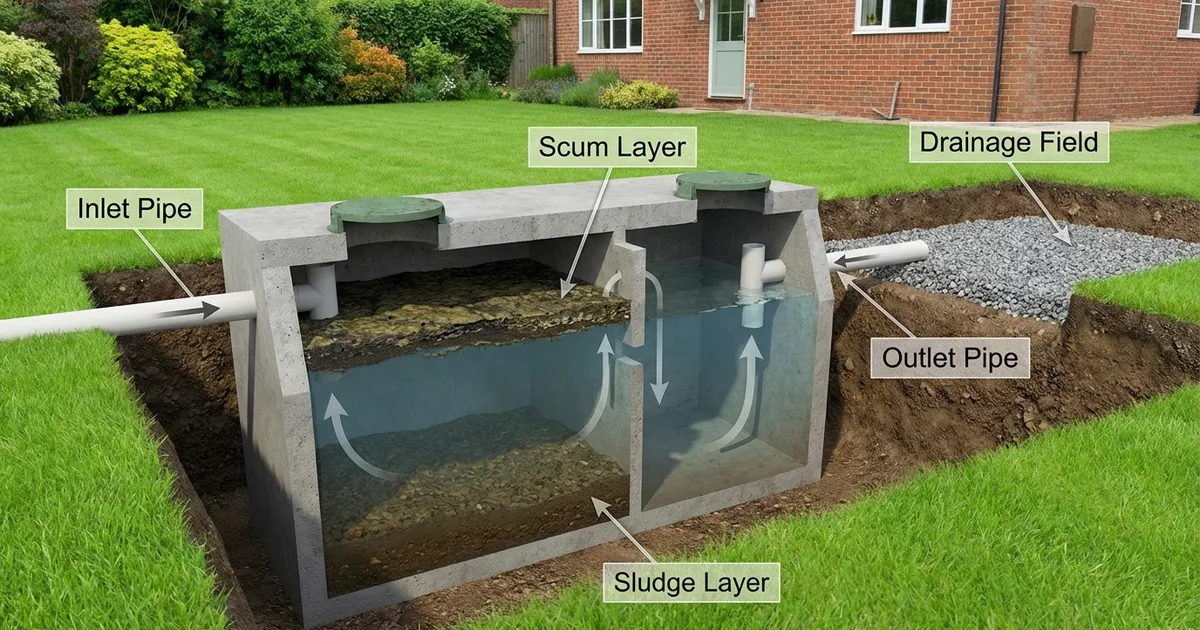
All household wastewater, from toilets, sinks, baths, showers, and washing machines, flows into the tank through the inlet pipe. A T-pipe or baffle at the inlet directs the flow downward, preventing it from disturbing the layers that have already settled inside.
Once inside, gravity does the work. Heavy solids sink to the bottom of the tank and form a layer called sludge. Lighter materials, fats, oils, and grease, float to the surface and form a layer called scum. The partially treated liquid sitting between these two layers is the effluent.
Stage 2: Anaerobic Digestion
Bacteria that thrive in oxygen-free environments, known as anaerobic bacteria, slowly digest the organic matter in the sludge. This biological process reduces the volume of sludge over time, but it is slow and incomplete. It does not produce clean water. It does not eliminate the sludge entirely. The bacteria reduce it, but they cannot remove it.
This is the critical point most guides gloss over. Anaerobic digestion buys you time between empties. It does not replace emptying.
Stage 3: Outlet to the Drainage Field (Soakaway)
Clarified effluent exits the tank through an outlet T-pipe, which is positioned to draw liquid from the middle layer while keeping sludge and scum inside. The effluent then flows into the drainage field (also called a soakaway), a network of perforated pipes laid in gravel-filled trenches beneath the ground. If you have ever wondered how does a soakaway work, this is it: effluent seeps through the pipes and percolates down through the soil, where bacteria, pathogens, and remaining nutrients are naturally filtered out.
The soil is the final treatment stage. Without it, the system does not work. A septic tank drainage field is not optional infrastructure. It is the part that makes the effluent safe before it reaches groundwater.
The effluent leaving a septic tank is not treated water. That is why the General Binding Rules prohibit septic tanks from discharging directly to any watercourse. The drainage field does what the tank alone cannot.
Picture the flow as a simple septic tank diagram: toilet → inlet pipe → first chamber (sludge sinks, scum floats) → baffle wall → second chamber (further settling) → outlet pipe → drainage field trenches → soil treatment → groundwater. Every stage depends on the one before it.
Key Components of a Septic Tank System
- Inlet pipe and baffle/T-pipe: Directs incoming wastewater downward so it enters the tank without churning up the settled sludge layer.
- First chamber (primary settlement): The largest chamber and the one that fills fastest. Most sludge and scum accumulates here.
- When the dividing walls and apertures between chambers get blocked, solids escape into the next stage. These internal baffles are the barrier that keeps sludge away from the outlet.
- Second chamber (and third, if fitted): Provides additional settlement time. Effluent leaving this chamber has fewer suspended solids than what entered it.
- The outlet pipe and T-pipe is the last line of defence. If this fails, sludge reaches the drainage field and the real expense begins.
- Drainage field (soakaway): Sits outside the tank itself. A network of perforated pipes in gravel-filled trenches where the soil does the final treatment work, filtering out harmful bacteria and nutrients as the effluent moves downward.
Each component depends on the others. A blocked baffle means solids reach the outlet. A failed outlet T-pipe means sludge reaches the drainage field. A clogged drainage field means the entire system backs up.
2-Chamber vs 3-Chamber Septic Tanks: What’s the Difference?
Most domestic UK septic tanks have two chambers: one main settlement chamber and a smaller secondary chamber. This is the standard configuration for residential properties and handles typical household volumes well. A 2-chamber tank is the norm for most 3 to 4 bedroom homes.
A three-chamber tank adds an extra stage of settlement before the effluent reaches the drainage field. The additional chamber gives suspended solids more time to drop out, meaning fewer particles reach the soakaway. That reduces the risk of drainage field blockage over time. For households of six or more, or properties with high water usage, the third chamber is worth the upgrade.
Both types use the same core process. The third chamber is an enhancement, not a different technology.
Older UK tanks are often single-chamber brick or concrete structures with no internal division at all. If you have one of these, modern replacements are typically two-chamber or three-chamber units made from GRP (glass-reinforced plastic) or polyethylene. Regardless of how many chambers your tank has, sludge builds up in every one of them.
Why Sludge Builds Up, and What Happens If You Don’t Empty It
Anaerobic digestion reduces sludge volume, but it never eliminates it. Flushing the toilet, running a bath, doing the laundry: it all adds solid material to the tank. Over months and years, the sludge layer rises.
When sludge reaches a critical level, it spills over the internal baffles and into the outlet pipe. From there it flows into the drainage field, where it blocks the perforated pipes and clogs the soil. Once a soakaway is saturated with sludge, it stops working. Replacing a failed drainage field costs thousands of pounds, and the system is effectively offline until the work is done.
Before that point, you will usually see warning signs: sewage smells in the garden, wet soggy ground above the drainage field where effluent is surfacing, or slow drains inside the house. Ignore those signs and you face regulatory enforcement from the Environment Agency on top of the repair bill.
The Environment Agency’s General Binding Rules require desludging at least once a year, or more frequently if the manufacturer’s instructions specify it. Most domestic tanks need emptying every one to three years depending on household size and tank capacity. The company that carries out the desludging must be an EA-registered Upper Tier waste carrier. Using an unregistered operator is illegal, and the homeowner remains liable regardless of who they hired. For a full breakdown of what emptying costs, see our septic tank emptying cost guide.
UK Septic Tank Regulations: What Every Homeowner Must Know
The legal framework is not advisory. These are enforceable requirements, and penalties for non-compliance can reach £100,000.
In England, the General Binding Rules have been in force since 1 January 2020. The key requirements:
- Septic tanks may not discharge directly to a watercourse. All discharge must go to the ground through a drainage field.
- The system must be maintained properly and desludged at least once a year.
- The waste carrier who removes the sludge must be an EA-registered Upper Tier carrier. They must issue a Waste Transfer Note for every collection. Keep these on file.
- Annual inspections are strongly recommended by the EA.
The deadline for removing illegal watercourse discharges passed six years ago. There is no grace period, no transitional arrangement, and no exemption for properties that never got around to it.
Scotland (SEPA) and Northern Ireland (DAERA/NIEA) enforce similar rules. You are responsible for maintaining your system, emptying it regularly, and ensuring it does not pollute.
Signs Your Septic Tank Needs Emptying
If any of the following are present, your tank likely needs emptying now, not in a few months.
- Slow-draining sinks, baths, or toilets throughout the property
- Gurgling sounds from the drains after flushing or running taps
- Sewage smells in the garden, particularly near the tank or drainage field
- Wet, soggy ground above the drainage field where effluent is surfacing
- The tank lid appearing to bulge, or visible sewage around the inspection cover
Any one of these symptoms means the system is under stress. Don’t wait for the smell to get worse.
If you are seeing any of these, the next step is straightforward: find an EA-registered emptying company in your area.
You now understand how a septic tank works, what sits inside it, and why the sludge that accumulates will never take care of itself. The three-stage process is reliable when maintained and expensive when ignored. The law is clear: empty it at least once a year, use an EA-registered Upper Tier waste carrier, and keep the paperwork.
Only registered waste carriers are legally permitted to desludge your tank. Find an EA-registered septic tank emptying company near you through our directory, where every listing is verified against the official EA waste carrier register.
Find a Registered Emptying Company Near You
Every company in our directory is verified against the official EA waste carrier register. Search by region, county, or city to find a specialist near you.
Search the Directory →