Can I Empty My Own Septic Tank? UK Law, Penalties, and How to Verify a Contractor
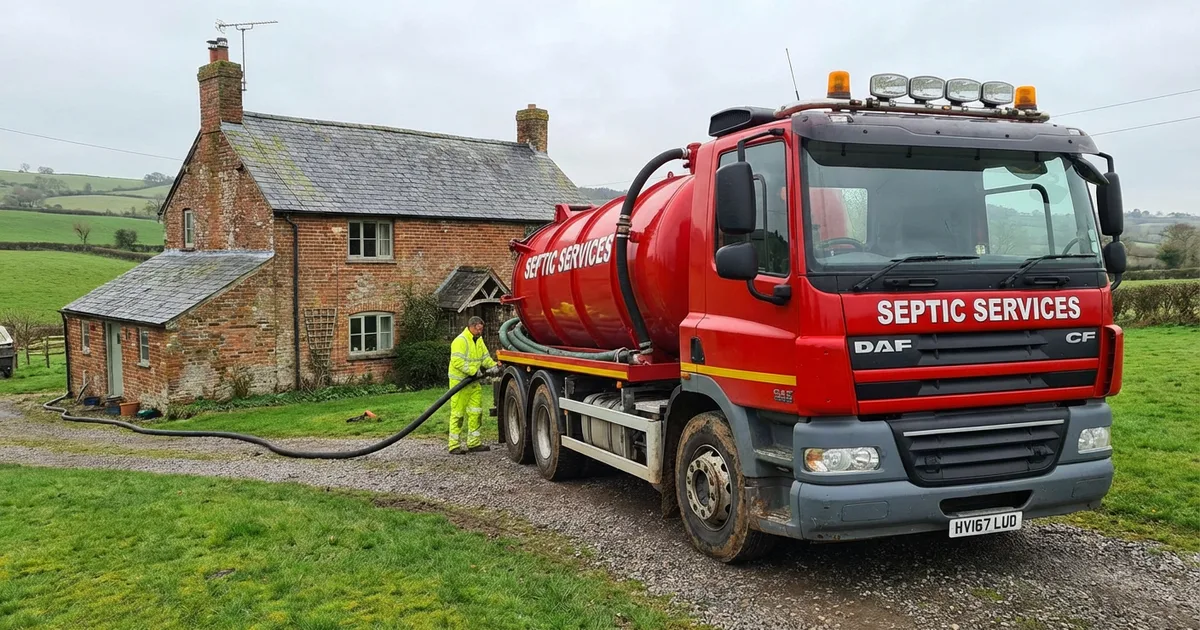
Most homeowners know you cannot empty a septic tank yourself. What fewer realise is that hiring the wrong person to do it carries exactly the same legal risk, and the liability sits with you, not them.
The farmer next door who offers to pump it out. The bloke with a van who does it “on the side.” The handyman who says he can sort it for cash. Every one of these scenarios potentially exposes you to prosecution under the Environmental Protection Act 1990, with penalties that include unlimited fines and up to five years in prison.
If someone has quoted you a price and you cannot verify whether they are registered, or if you are weighing up whether to do it yourself to save £200, you are one emptying away from an unlimited fine. Here is the law on septic tank emptying UK law, the penalties, and how to check any contractor in 60 seconds.
Why Septic Tank Sludge Is Controlled Waste (And What That Means for You)
Septic tank sludge, sometimes called septage, is classified as controlled waste under the Environmental Protection Act 1990. That classification is not a technicality. It means the waste must be handled, transported, and disposed of under strict legal controls from the moment it leaves your tank.
Three pieces of legislation create this framework:
- EPA 1990, Section 33 makes it an offence to deposit, treat, keep, or dispose of controlled waste without a waste management licence.
- EPA 1990, Section 34, the Duty of Care clause, requires every holder of controlled waste to ensure it is only transferred to an authorised person. This is the clause that makes you, the homeowner, liable if you hand waste to someone who is not properly registered.
- The Control of Pollution (Amendment) Act 1989 and the Controlled Waste (Registration of Carriers and Seizure of Vehicles) Regulations 1991 require anyone carrying controlled waste commercially to hold an Upper Tier waste carrier registration with the Environment Agency.
A homeowner cannot obtain Upper Tier registration for one-off domestic use. It is a commercial licence. You cannot legally transport septic tank sludge yourself, and you cannot legally hand it to anyone who does not hold that registration. The law does not distinguish between DIY septic tank emptying and using an unregistered carrier. Both put the property owner at risk.
What Are the Actual Penalties? (The Numbers Most Guides Don’t Publish)
Other guides will tell you that you “could face fines.” Here are the actual figures from current legislation.
If you use an unregistered carrier (Duty of Care breach, Section 34):
- Fixed Penalty Notice: up to £300
- Prosecution: unlimited fine (no statutory cap)
If you do it yourself, the illegal deposit or disposal of controlled waste (Section 33):
- Fixed Penalty Notice: up to £1,000 (increased from £400 by The Environmental Offences (Fixed Penalties) (Amendment) (England) Regulations 2023)
- Magistrates’ Court: unlimited fine plus up to 12 months imprisonment
- Crown Court: unlimited fine plus up to 5 years imprisonment
The Environment Agency can and does investigate. If inspectors visit your property and you cannot produce Waste Transfer Notes proving your waste was handled by a registered carrier, you face a Duty of Care investigation regardless of who actually did the work.
There is one scenario where DIY disposal is technically legal, but it is far narrower than most people assume.
Can I Empty My Own Septic Tank? The Agricultural Exception
This is the scenario most people ask about: can my farmer neighbour empty my septic tank UK? The short answer is that there is a legal route, but it almost certainly does not apply to your situation.
Under the Sludge (Use in Agriculture) Regulations 1989, septic tank sludge may be spread on genuinely agricultural land without being classified as controlled waste. But only if all four conditions are met:
- The land must genuinely qualify as agricultural, meaning it is actively used for growing crops or grazing livestock.
- The sludge must have been tested and must meet specific contaminant limits.
- Detailed records of the spreading must be kept.
- The spreading must not cause harm to the environment or human health.
In practice, a farmer neighbour cannot simply pump your tank and spread the contents on their field without fulfilling every one of those conditions. “Agricultural” does not mean a large garden, a paddock with a pony, or a smallholding that does a bit of grazing on the side. The EA will prosecute if the conditions are not met, as confirmed by the Waste Duty of Care Code of Practice.
This exception is rarely applicable to domestic homeowners. Do not rely on it without professional legal advice.
The Safety Case: Why Even Experts Won’t Enter a Septic Tank Without Full Equipment
Around 15 people die in confined space accidents in the UK each year. Sixty percent of those fatalities are the person who went in to help. Septic tanks are confined spaces, and they produce hydrogen sulphide (H2S), a gas that is heavier than air, pools at the bottom of the tank, and kills your sense of smell before it kills you. Above 300 ppm, it causes rapid unconsciousness and death.
At low concentrations, H2S smells like rotten eggs. At higher concentrations, it destroys your ability to detect it entirely. You will not know the danger by the time it becomes lethal.
Septic tanks also produce methane, which is both an asphyxiant and highly flammable in enclosed spaces.
Under the Confined Spaces Regulations 1997, septic tanks are classified as confined spaces. For workers, entry without proper equipment, training, and a documented rescue plan is illegal. Do not enter the tank. Do not send a family member to check. Do not go in after someone who has fallen in. Call 999 and wait for the fire service.
The Waste Transfer Note: Your Legal Shield (Keep It for 2 Years)
Whether you have already booked someone or are still looking, there is one document you must demand every time your septic tank is emptied: a Waste Transfer Note (WTN).
A Waste Transfer Note records:
- The carrier’s registration number
- What waste was removed, including the European Waste Catalogue (EWC) code
- The quantity removed
- Where the waste was taken for disposal or treatment
- The date, plus signatures from both parties
You must retain WTNs for a minimum of 2 years, as required by the Waste Duty of Care Code of Practice. If the Environment Agency inspects your property and you cannot produce them, you face a Duty of Care investigation even if you did use a legitimate contractor.
If a contractor refuses to provide a Waste Transfer Note, do not use them. This is the single clearest sign that they are operating without proper authorisation. Ask for the WTN before they leave your property. Do not rely on them posting it later.
How to Verify a Waste Carrier Is Legitimate (Takes 60 Seconds)
Before you hand over any money, run through this registered waste carrier check:
- Ask the contractor for their EA waste carrier registration number. The format is CBDU followed by digits.
- Search the EA public register of waste carriers, brokers and dealers.
- Confirm they are registered as Upper Tier. Lower Tier registration is for businesses that only carry their own waste. It does not cover commercial emptying of your septic tank.
- Check the registration expiry date. It must be current.
If the property is in Scotland, use the SEPA waste carriers register. In Wales, use the Natural Resources Wales register.
Or skip the manual checking entirely. Every company listed on Septic Tank Register UK has been verified against the EA Upper Tier register. Search our directory of verified EA-registered companies by region, county, or city to find a specialist near you.
For most households emptied once or twice a year, the choice between DIY and professional is really a choice between a £200 job and an unlimited fine. At £150 to £250 per emptying, a registered carrier is the cheapest legal protection you will ever buy. For a full breakdown of what professional emptying typically costs across the UK, see our septic tank emptying cost guide.
Find a Verified Emptying Company Near You
Every company in our directory is checked against the official EA Upper Tier waste carrier register. Search by region, county, or city.
Search the Directory →