Cesspit vs Septic Tank: What’s the Difference and Which Do You Have?
If you’ve just moved to a rural property and your water bill shows no sewerage charge, you’re on a private drainage system. Whether that system is a cesspit or a septic tank could mean a difference of over £2,000 a year in running costs.
The financial gap is only one part of it. The type of system buried in your garden also determines your legal obligations under the Environment Agency’s 2020 rules, how often you need to call an emptying company, and which kind of registered professional you actually need.
Most homeowners discover all of this too late, usually when the first emptying bill lands or a surveyor flags a compliance problem during a property sale. So if you have a mystery tank in the garden and no idea what it is, start with the comparison table below. If you already know what you have, skip straight to the regulation and cost sections.
Cesspit vs Septic Tank: Key Differences at a Glance
If you already have a rough idea of both systems, this table gives you the full picture in 30 seconds.
| Feature | Cesspit (Cesspool) | Septic Tank | Sewage Treatment Plant |
|---|---|---|---|
| Has outlet? | No, fully sealed | Yes, to drainage field | Yes, to drainage field or watercourse |
| Treatment? | None, holding only | Partial (anaerobic) | Full (mechanical aeration) |
| Emptying frequency | Every 4 to 8 weeks | Every 1 to 3 years (desludging) | Every 1 to 2 years |
| Annual running cost | £600 to £3,250+ | £75 to £300 | £100 to £400 |
| Subject to GBR 2020? | No | Yes | Yes |
To identify which system you’re actually dealing with, it helps to understand how each one works.
What Is a Cesspit (and Why “Cesspool” Means Exactly the Same Thing)
First, the terminology. In UK usage, “cesspit” and “cesspool” are interchangeable. They refer to exactly the same thing. If you’ve been searching for “cesspool vs cesspit vs septic tank” thinking these are three different systems, they’re not. A cesspool is a cesspit. Two words, one tank.
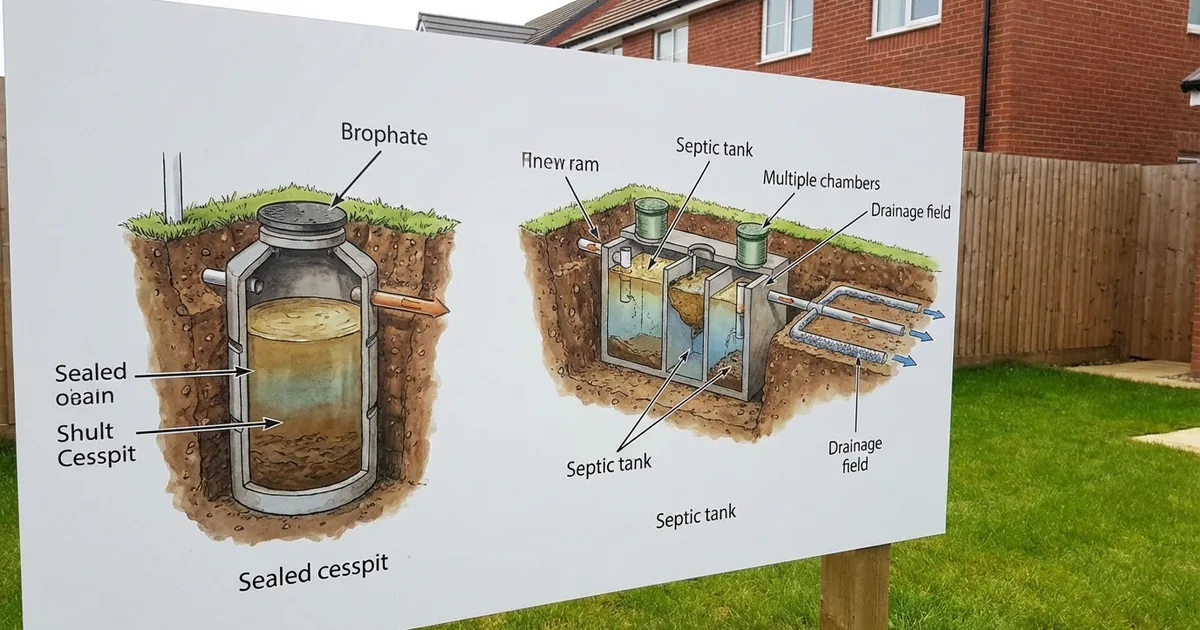
A cesspit is a fully sealed, single-compartment underground holding tank. Sewage and wastewater flow in from your property. Nothing flows out. There is no outlet pipe, no drainage field, and no biological treatment. The tank simply accumulates waste until a licensed tanker arrives and pumps it empty.
Building Regulations require a minimum capacity of 18,000 litres for a one-bedroom property, with an additional 6,800 litres for each extra bedroom or occupant. The tank must be capable of holding at least 45 days’ worth of effluent under BS6297. In practice, most household cesspits need emptying every 4 to 8 weeks.
So why do cesspits still exist if they cost so much more to run?
- Many were installed in older, pre-war rural properties before septic tanks became standard.
- In some areas, the soil simply won’t support a drainage field. Clay-heavy ground, a high water table, or proximity to a watercourse can all rule out a septic tank.
- Some plots are too small for a drainage field.
- Retrofitting is expensive: replacing a cesspit with a septic tank and drainage field typically costs £3,000 to £10,000 or more, depending on ground conditions and access.
One final note: cesspits are legal in England and Wales but illegal in Scotland. If you need a cesspit emptying company, make sure they are an EA-registered Upper Tier waste carrier.
What Is a Septic Tank?
A septic tank is an underground wastewater treatment system, typically with two or more chambers. Sewage flows in through an inlet pipe. Inside the tank, anaerobic bacteria break down solid waste. The heavier sludge sinks to the bottom, lighter scum floats to the top, and the partially clarified liquid in the middle flows out through an outlet pipe to a drainage field.
The drainage field (sometimes called a soakaway) is a network of perforated pipes buried in gravel trenches. The liquid effluent percolates through the gravel and into the surrounding soil, where naturally occurring bacteria complete the treatment process.
The solid sludge that accumulates at the bottom of the tank needs to be removed periodically by a registered septic tank emptying company. For most households, this means desludging every 1 to 3 years, far less frequent than a cesspit.
One practical identification tip: drainage fields often appear as an area of unusually green or lush grass in the garden, sometimes in a grid or herringbone pattern. If you can see a strip of bright green lawn that looks healthier than the rest, there’s a good chance you’re looking at your soakaway.
A third option exists: the sewage treatment plant (STP). This is a more advanced system that uses mechanical aeration to produce cleaner effluent. With the correct permit, an STP can discharge directly to a watercourse rather than a drainage field. STPs are increasingly common in new rural builds, but they’re a separate topic and not the focus here.
The Regulation Difference That Most Guides Get Wrong
If you’re buying a rural property, this is the section that could save you thousands.
The Environment Agency’s General Binding Rules (GBRs) came into force on 1 January 2020. They changed what is required of septic tanks in England: septic tanks can no longer discharge directly to surface water such as rivers, streams, or ditches. Every septic tank must now drain to the ground via a drainage field. If your septic tank is discharging to surface water, you are required to either upgrade the system, install a drainage field, or apply for an environmental permit. That can be a costly obligation, particularly if the property’s geography makes a drainage field difficult.
Here is the part most guides get wrong: the General Binding Rules do not apply to cesspits. A cesspit has no outlet and no discharge, so there is nothing for the GBRs to regulate. If you have a cesspit, you do not need an environmental permit, an exemption registration, or GBR compliance.
The legislation that does apply to cesspits is different. The Environmental Permitting (England and Wales) Regulations 2016 and the Public Health Act 1936 give local authorities the power to inspect cesspits and require owners to maintain them to prevent public health hazards. But these are not the same technical requirements as the GBRs.
Why does this matter for buyers? If you are purchasing a rural property with a private drainage system, check whether the existing septic tank discharges to surface water. If it does, that is a required upgrade, either before or after purchase, and the cost falls on the owner. If the property has a cesspit instead, there is no GBR compliance issue, but the ongoing running costs will be significantly higher.
The GOV.UK guidance is unambiguous: if you have a septic tank, you must comply with the General Binding Rules. If you have a cesspit, you don’t.
What Each System Actually Costs to Run
The headline figures in the table above look stark. They get worse in context.
A single cesspit emptying visit costs between £100 and £250, depending on the volume and your location. At the Building Regulations minimum of emptying every 45 days, a standard household is looking at roughly 8 empties per year. That puts the annual cost at £800 to £2,000. The table’s £600 lower end reflects smaller households or less frequent schedules; the upper end accounts for larger tanks. A 24,000-litre cesspit emptied every 40 days can cost approximately £5,400 per year.
Septic tank desludging is a different picture entirely. A single desludge costs £150 to £300, and most households only need it once every 1 to 3 years. The annual equivalent works out at £75 to £300. That is a 5 to 10 times cost difference for the same basic function: getting rid of your household’s wastewater. For a detailed breakdown, see our septic tank emptying cost guide.
Installation costs run in the opposite direction. A cesspit is structurally simpler, just a sealed tank in the ground, so it is cheaper to install. A septic tank requires a drainage field survey, percolation testing, and groundworks, which adds to the upfront cost. But the running costs dwarf the installation difference within a few years.
If you have a cesspit and your soil conditions allow it, upgrading to a septic tank or sewage treatment plant is worth investigating. The payback period on the capital cost can be under five years, and after that you are saving £1,000 or more every year.
How to Tell If You Have a Cesspit or Septic Tank: 6 Steps
Steps 2 and 6 are the fastest for most people. If you want to be thorough, work through all six.
- Check your water bill. Look at your most recent water bill. If there is no “sewerage” or “wastewater” charge, you are on a private drainage system. This confirms you’re not connected to the mains sewer, but it does not tell you whether you have a cesspit or a septic tank. It is a starting point only.
- Look for a drainage field. Walk your garden. A septic tank requires a drainage field (soakaway), and cesspits do not have one. Look for an area of unusually green or lush grass, particularly in a grid or herringbone pattern. This is the strongest visual indicator that you have a septic tank. No such area and the garden looks uniformly the same? Most likely a cesspit. This check is free and takes five minutes.
- Check for an outlet pipe. A cesspit is completely sealed with no outlet. A septic tank has a visible outlet chamber where the treated liquid exits toward the drainage field. If you can safely lift the inspection cover on your tank, look for an outlet pipe on the opposite side from where the sewage enters.
- Review property deeds and surveys. Your conveyancing pack, Land Registry documents, original installation certificate, or building regulations documentation may name the system type explicitly. A homebuyer survey or structural survey will often include a section on drainage. Check these before you start digging around in the garden.
- Check emptying frequency records. Emptied every 4 to 8 weeks? Almost certainly a cesspit. Desludged once in 1 to 3 years? Septic tank. Ask the previous owner or their solicitor for emptying receipts. The pattern is unmistakable.
- Call the previous emptying company. Any EA-registered waste carrier who has serviced the property will know the system type from their own records. They will have noted it on their first visit. If you can find the company name on an old receipt, a note from the previous owner, or a sticker on the inspection cover, one phone call will give you a definitive answer.
Now You Know. What to Do Next
Whichever system you have, one rule applies to both: the company that empties it must be an Environment Agency registered Upper Tier waste carrier. This is a legal requirement, not a recommendation. Using an unregistered operator is illegal for the carrier and leaves you, as the homeowner, exposed if anything goes wrong.
Both cesspit emptying and septic tank desludging require specialist tanker vehicles and access to licensed disposal facilities. Not all general waste contractors qualify, and not all drainage companies cover every area.
An estimated 1 to 3 million UK households rely on off-mains drainage, but finding a verified, registered specialist in your area is not always straightforward. That is the problem this directory exists to solve.
Find a Registered Emptying Company Near You
Every company in our directory is verified against the official EA waste carrier register. Search by region, county, or city to find a specialist near you.
Search the Directory →